
Ecological Nutrition is Now Wholly Her. Here's Why.
A couple of months ago, I had several new clients onboard with me in the same week. And a number of my new female clients had had their uterus removed because of period problems. None had ever had their hormones tested properly.
When I started in natural medicine, I wanted to understand why people got sick, and to go further than Western medicine had for them. Over the years, I’ve worked with a wide range of complex conditions, and I’ve seen people improve in ways I hadn’t expected. I thought I was heading in the right direction.
But that week, when so many of my new female clients had had hysterectomies, stopped me in my tracks. It made me rethink what I was doing.
I could understand the need to make these women’s lives easier. They had all been living with erratic cycles, heavy bleeding that often led to anaemia, frequent and debilitating pain, changes in mood, plus a host of other symptoms that made life unbearable. So from the perspective of giving them relief, restoring some quality of life, it made perfect sense.
The big problem for me was that I couldn’t see evidence of any major attempt by any of their previous treating practitioners to fully understand why they were experiencing what they were. Not one of them had actually had their hormones tested properly - no specification for oestrogen, luteinising hormone, follicle-stimulating hormone, and androgen on days 2-4 of their period. No one ever checked progesterone on day 21-equivalent. And beyond iron status, no one was looking for what might be causing low oxygen supply to their uterine area.
A hysterectomy can be the right decision, and nobody reading this should feel judged for having had one. What troubled me was that nobody had asked why. That, to me, was a tragedy.
And it got me wondering: why did this happen? How many other women had this happen to them? And why are women’s organs seen as so unnecessary that they just get removed?
So, I started to do some digging. And what I found shocked me.
What I found
I knew from my own experience that women’s healthcare was dismal at best, and that women were often dismissed as complainers by Western medicine, only to get a diagnosis years later.
But the history of dismissing women’s issues goes back much further than our most recent iteration of medicine. Three things every woman needs to know:
Women were frequently diagnosed with hysteria for 3,900 years. The word comes from the Greek for uterus, and the diagnosis began with the idea of a wandering womb. Hysteria stayed a live diagnostic concept, not formally removed from psychiatric classification until the DSM-III in 1980.
Women have been excluded from medical research. From 1977–1993, the FDA formally excluded “women of childbearing potential” from early-phase drug trials. Many of the drugs on the market today have limited efficacy or safety data in women.
The vulva has been viewed by medicine as shameful. The international standard for anatomical terms listed the female external genitalia as the pudendum, Latin for “shameful part”, until it was dropped in 2019. Many of the nerves still carry the legacy in their names.
These are big things that every woman being treated by Western medicine should know. There is a history and a legacy of brushing women off as hysterical, of excluding them from research, and of seeing female genitalia as shameful.
What the local data shows
But I was also amazed to learn more about what was happening in my local area. Here are a some statistics about Ballarat:
Women in Ballarat experience endometriosis-related hospitalisations at a rate 2.5 times the Victorian average. This is based on hospitalisation rates, not a disease prevalence rate, so we can’t say endometriosis is more common amongst Ballarat women - but it suggests this may be the case.
Ballarat’s hysterectomy rate was 3.8 per 1,000 women in 2022, compared with 2.19 statewide — 74% higher. Ballarat ranked fourth-highest in Victoria, with the three higher-rate LGAs—Yarriambiack, Golden Plains and Pyrenees—also in the broader Grampians/Ballarat healthcare region; Moorabool and Central Goldfields followed closely behind. This geographic clustering raises questions about both regional gynaecological disease burden and shared referral/treatment practices.
Women in Ballarat are more likely to experience physical threat in their own home. The average rate of family violence (and men are identified as perpetrators in over 75% of incidents) across Victoria is 1,708 per 100,000 residents. In Ballarat, the rate is 2,385 per 100,000, 40% higher than that state average.
Women in Ballarat are likely disproportionately affected by chronic health conditions. According to the 2022 National Health Survey, 51.8% of women in Victoria report a chronic health condition, compared to 46.5% of men. Meanwhile, Ballarat residents are impacted by two or more chronic health conditions at a rate 41% higher than the state average.
Ballarat women are likely disproportionately affected by anxiety, depression and psychological distress. Victorian women report high or very high psychological distress at a rate 35% higher than men, while in Ballarat, long-term mental health conditions are reported as 49% higher than the state average. The rate of suicide in Ballarat is 41% higher than the state average.
If anything in this has brought up difficult feelings, Lifeline is available on 13 11 14, 24 hours a day.
I was also interested in looking at fertility rates in Ballarat, and conditions like PMOS (formerly PCOS), but unfortunately the data isn’t available. However, I have seen plenty of anecdotal evidence that these are more prevalent based on what I see on local social media pages and also my local caseload. Neither of these is definitive, but they are indicative.
Over the last few years, I’ve grown used to my female clients telling me their history: the various complaints they’ve had, how they’ve been treated (or not), investigated (or not), and about the tenuous relationship that they almost invariably have with their doctor. I would estimate that more than 50% of the time after I send them off with a letter for their doctor for further testing, they come back with a pathology request that contains nothing other than what’s been tested and failed to explain their symptoms for the last twenty years. Compare that to my male clients, who generally (with a few exceptions) tell me everything was fine and there was no problem with getting what I’d requested when they went to their doctor.
What is (and isn’t) changing
So, where does all this leave me?
I was already justifiably (in my mind, anyway) outraged by the attitude of a lot of other people in the healthcare space when it comes to women’s health, based on my own experience and the clear divide between men’s and women’s healthcare in my clients. But I was furious as I read some of these - and many more statistics - about the gender disparity in healthcare.
There is a growing awareness and vocalisation of this disparity - it’s all across social media, if you care to look. This is a great first step, because if we’re aware of it and we’re talking about it, people can start taking the steps needed to make change. But that change isn’t coming nearly fast enough for the women I work with. And it’s definitely not being implemented in a way that’s meaningful amongst women with chronic health conditions, especially in my local area.
I realised that women need to know there is somewhere they can go to get the kind of comprehensive investigation and care they seek. Somewhere they will be seen, heard, and understood. Somewhere that outright rejects the notion of female hysteria. Somewhere that treats their body in its own right, not just a smaller and more shameful version of a man’s.
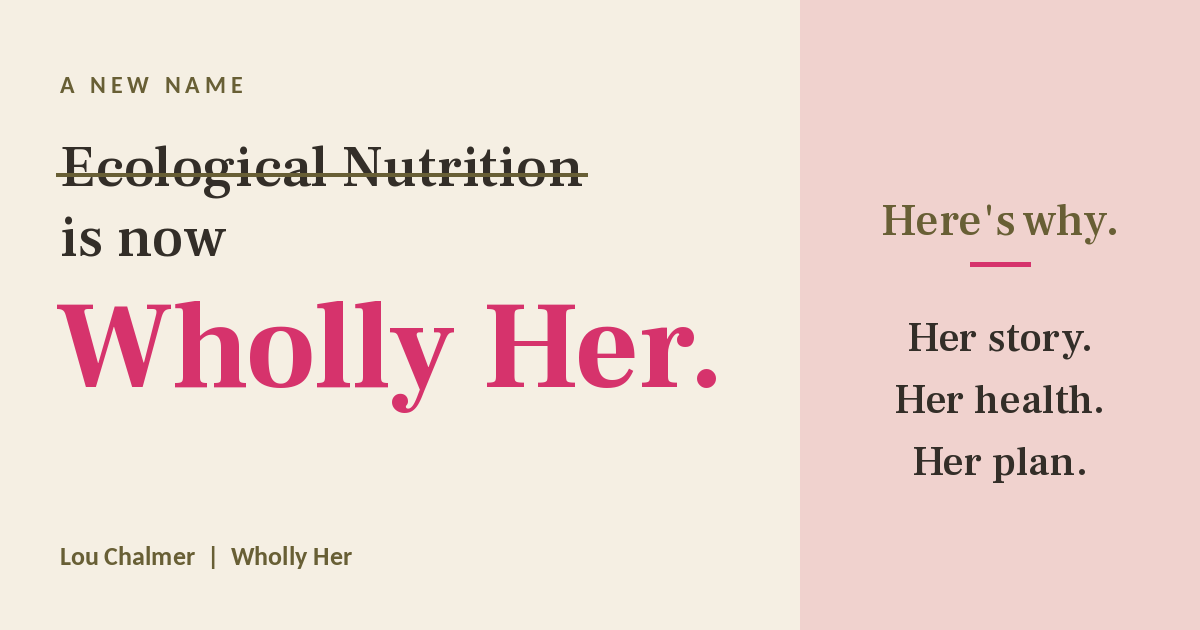
That’s why Ecological Nutrition has now become Wholly Her, to fulfil that need. Wholly, because I look at the whole person. Her, because that’s who I want to be here for.
This is a big change, but there are some things that aren’t changing.
I still work with complex, chronic health conditions. I still work with the whole person, from a systems perspective. And I still take a capacity-first approach.
My male and boy clients are more than welcome to stay - in fact, I would feel incredibly privileged if they did. I also won’t be turning new male clients away. Referrals of friends, partners, or children are all still welcome.
What is changing is my educational resources and content. These will increasingly be written and produced with women and their needs in mind. I already have a number of free resources for women, which you can find here. You can expect this catalogue to continue growing over time.
You can also sign up to my bi-weekly newsletter here if you’d like to receive research updates and clinic insights from me, many of which are specific to women’s health.
I don’t expect Wholly Her to change the system. It can’t, on its own. But it can change what happens in one room, for one woman who’s been told for the third or fourth time that her tests are fine.
I can’t promise what we’ll find. I can promise to look properly, and to take her seriously while I do.
If that’s what you’ve been looking for, I’d love to hear from you. And if it isn’t, but you know someone it might help, send her this.